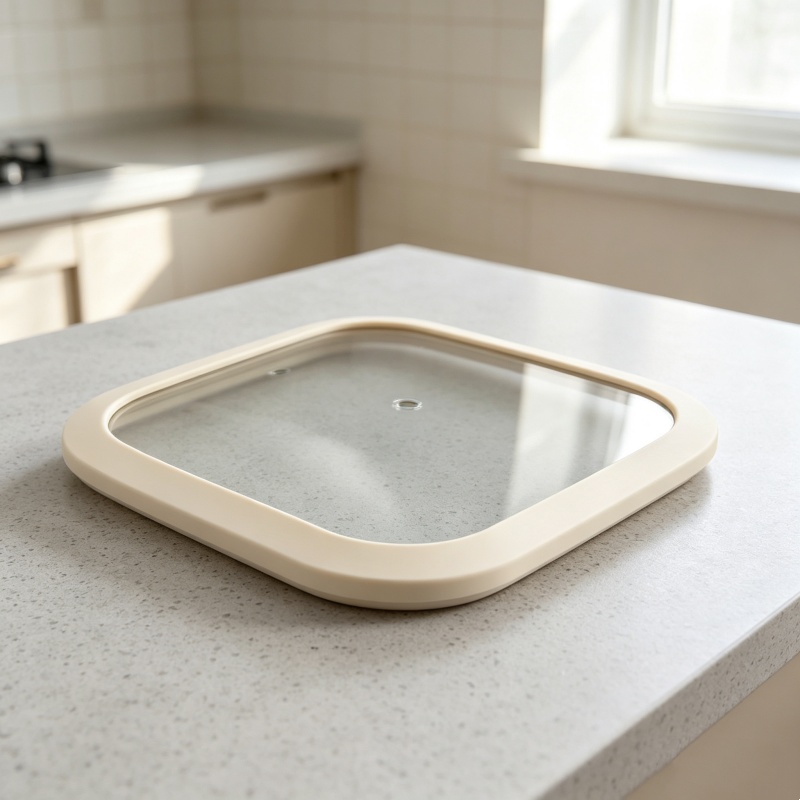
1. Stress Concentration at Square Corners Causes High Breakage Rate of Tempered Glass
Circular glass bears uniform clamping force and silicone injection pressure during molding, while the four right-angle corners of square glass gather most clamping pressure and fluid silicone impact force during mold closing and LSR injection. Even fully tempered glass is prone to invisible micro-cracks, corner chipping or direct breakage during production.
In addition, tempered glass has a natural thickness tolerance of ±0.1mm after cutting and tempering. When the mold rigidly clamps the square glass blank, thin edges and corners will bear excessive pressure and crack easily.
During high-temperature vulcanization (160°C~195°C), silicone expands violently after heating and squeezes the four corners of the glass continuously. Residual internal stress accumulates inside the glass. Some finished lids will crack automatically after being stored for several days without collision.
To solve this problem, the mold must adopt a floating buffer positioning structure equipped with nitrogen springs for adaptive clamping instead of rigid compression, which raises the mold cost to 1.8~2.5 times that of circular glass lid molds.
2. Poor Adhesion Between Glass & Silicone, Corner Delamination & Water Leakage Frequently Occur
In actual production, it is difficult to evenly spray silane primer and conduct plasma activation treatment around the entire square perimeter: corners tend to accumulate excessive primer to cause silicone foaming, while straight edges are prone to missing coating. The uncoated area will peel off integrally after repeated boiling and steaming.
For cookware used in kitchens with frequent alternating hot and cold environments (refrigeration + high-temperature cooking), ordinary bonding processes will suffer silicone detachment at four corners after hundreds of steaming cycles, resulting in water leakage of food storage pots and frying pans.
Standard qualified production flow must strictly follow: glass surface grinding activation → plasma cleaning → glass-specific silane primer coating → silicone wrapping molding within 8 hours, any omitted procedure will lead to batch delamination defects.
3. Unbalanced Mold Venting Traps Air, Causing Bubbles, Incomplete Filling & Burnt Spots at Corners
Trapped air brings three major defective phenomena: tiny bubbles & pinholes on silicone edges, burnt black spots caused by high-temperature air compression, and incomplete silicone filling at corners to form broken sealing edges.
If the exhaust grooves at corners are opened too wide to release air, severe flash burrs will be generated; narrow exhaust grooves inevitably cause air trapping. The micron-level segmented design of exhaust grooves becomes the core technical threshold of the mold.
For multi-cavity mass production molds, it is hard to balance the silicone flow rate of each cavity, resulting in inconsistent bubble defect rates of square lids produced in different cavities, which greatly damages production stability.
4. Hard to Control Uniform Silicone Thickness Around Four Sides, Unqualified Sealing Performance
- Thin silicone position: insufficient compression allowance after lid closing, leading to air leakage and water leakage during sealing;
- Over-thick silicone at corners: the edge protrudes outward after molding, making the lid unable to close tightly and warp upward.
Cookware lids require the tolerance of silicone thickness around the perimeter to be controlled within ±0.05mm to guarantee consistent sealing effect. Manual feeding production lines usually have a yield lower than 75%, and only automated manipulator precise positioning can meet the thickness control standard.
5. Residual Thermal Stress Induces Hidden Cracks & Edge Warping in Finished Products
In daily household use, alternating cold and hot environments (refrigerated at 0℃, heated above 100℃) repeatedly impact stressed corners, triggering two common after-sales problems:
- Silicone edges tear gradually from the corners;
- Invisible micro-cracks expand inside glass corners, and the glass breaks once slightly collided.
Unlike circular glass lids without circumferential tensile stress, square silicone-coated glass lids must adopt low-shrink LSR silicone formula, increasing raw material cost by 20%~35% compared with ordinary silicone.
6. Difficult Flash Trimming at Corners & Poor Consistency of Appearance Quality
Corner burr trimming faces a dilemma: manual trimming tends to tear the silicone at fragile corners by pulling force; cryogenic deflashing may cause brittle glass corners to crack due to low-temperature impact. Both trimming methods have hidden scrapping risks.
In mass production, it is easy to have inconsistent appearance: some lids have excessive burrs at corners, while others are clean. Differences in gloss and burr state cannot meet the appearance inspection standards of supermarkets and cross-border kitchenware brands.
Additional Cost Pain Points in Mass Production
- Complex mold structure with four-side positioning inserts, corner floating blocks and segmented exhaust structure, resulting in high mold development cost;
- The overall yield rate is 15%~25% lower than circular silicone-wrapped glass lids, bringing greater waste loss;
- The whole technological chain is longer, including glass cleaning, plasma activation, primer drying, precise positioning wrapping and secondary vulcanization, and batch defects will occur once any process fluctuates.
Post time: Aug-06-2026