Although it looks like a simple aluminum shell, the Aluminum Flame Guard for cookware handle faces multiple tough technical hurdles in design and volume production, which directly determine assembly performance and long-term service reliability.
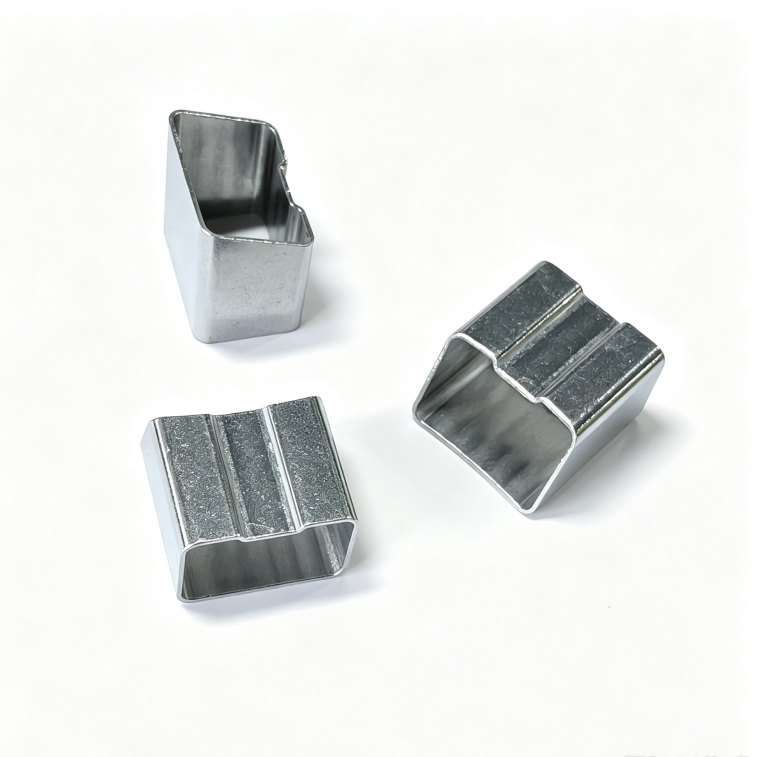
1.1 Precise forming control & aluminum springback
Aluminum features obvious springback after stamping, especially for irregular enclosures with notches and inner ribs. After mold pressure is released, the opening size, angle and notch position tend to deviate from drawing specifications. Even deviations within 0.1–0.3 mm will lead to difficult insertion or excessive clearance when fitting with die-cast handle inserts. Engineers must continuously optimize mold compensation angles and adjust blank holder force to offset springback, requiring repeated trial molding before mass production.
1.2 Dimensional consistency in mass production
Continuous stamping brings gradual mold wear. If without regular maintenance, the inner cavity size of the Aluminum Flame Guard for cookware handle drifts slowly. Poor consistency creates mixed qualified and unqualified products in the same batch. Automated size sorting is required, which increases factory investment. The enclosure wall thickness must remain uniform; partial thin walls will cause permanent deformation under sustained flame heating during kitchen use.
1.3 High-temperature structural stability
During cooking, the flame guard bears continuous radiant heat and convection heat. Poor structural design leads to thermal deformation. Rib reinforcement structures are added to many product models to enhance rigidity. Material selection also matters: low-purity aluminum will accelerate oxidation and discoloration under cyclic high temperature, affecting appearance and assembly clearance.
1.4 Surface quality and edge safety
Sharp burrs on trimming edges are a hidden risk. When assembled onto cookware, rough edges may scratch operators during assembly or cut consumers during cleaning. Full deburring is mandatory, yet excessive polishing changes overall dimensions. Balancing smooth edge finish and stable dimensional tolerance remains a common technical challenge for all manufacturers.
1.5 Compatibility matching between flame guard and handle assembly
The ultimate design goal of the Aluminum Flame Guard for cookware handle is seamless coordination with die-cast aluminum handle connectors. Minor mismatches on the lock notch, inner cavity profile and insertion depth will ruin the whole cookware assembly line. Successful product development requires close communication between the flame guard supplier and the handle mold developer to unify tolerance standards.
Outlook
Against the backdrop of booming global cookware trade, the Aluminum Flame Guard for cookware handle will continue to see steady market demand. Future competition will shift from simple low-price manufacturing to precision customization, stable quality control and joint new-product development. Factories that can solve forming technical pain points, shorten die development cycles and satisfy diversified certification requirements will build long-term cooperative relationships with global cookware brands. Continuous optimization on alloy material selection, stamping mold technology and automated inspection systems will become the core route to upgrade the whole industry of cookware flame guard components.
Post time: Aug-17-2026