|
Material: |
Aluminum alloy |
|
Size: |
10x12mm |
|
Shape: |
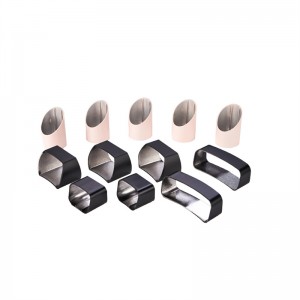
Square or rectangular |
|
OEM: |
Customized |
|
FOB Port: |
Ningbo, China |
|
Sample lead time: |
5-10days |
|
MOQ: |
1500pcs |
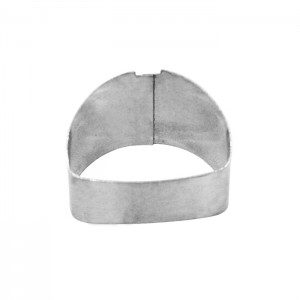
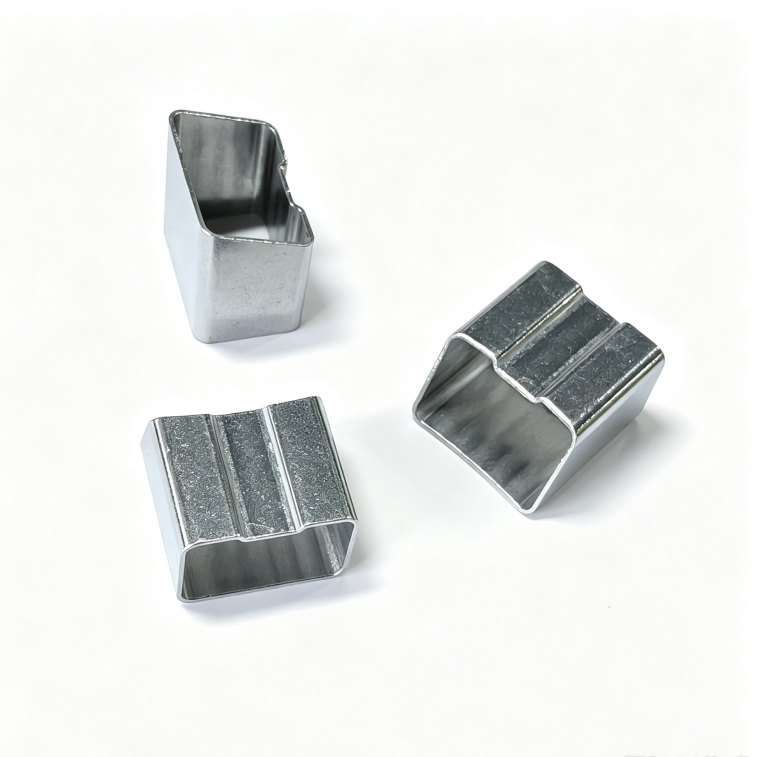
The Aluminum Flame Guard for cookware handle is a vital functional hardware component for modern pots and pans. Installed at the joint between cookware bodies and handles, it forms a physical barrier to block open flames from directly contacting plastic, bakelite or silicone handles.
It effectively prevents handle overheating, avoids scald risks for users, and extends the service life of heat-sensitive cookware handles.
As gas cookers remain mainstream in households across Europe, Southeast Asia, the Middle East and Latin America, this small aluminum part has become a standard supporting accessory for mid-to-high-end cookware exports.


Mass production of the Aluminum Flame Guard for cookware handle relies mainly on precision aluminum sheet stamping, supplemented by post-forming surface treatment.
The whole production workflow includes raw material selection, blanking, deep drawing, customized contour forming, trimming, deburring, cleaning and surface finishing.
Manufacturers normally select 1050 or 5052 aluminum alloy sheets. These grades feature moderate ductility, outstanding thermal reflectivity, natural oxidation resistance, and cost advantages compared to stainless steel.
The forming process demands custom dies tailored to different handle connector shapes. Many cookware brands require irregular notches, inner rib structures and special enclosure profiles to match their die-cast handle bases, which means nearly every new customer project needs targeted die development.
After stamping, parts go through chemical degreasing to remove oil stains from molding. Some orders require bright surface finishing or simple passivation treatment to achieve uniform metallic luster and resist kitchen grease corrosion. Production efficiency heavily depends on die stability.
For mature standardized models, automated stamping lines can reach tens of thousands of pieces per day; for customized special-shaped Aluminum Flame Guard for cookware handle, cycle time lengthens due to frequent dimensional inspection and manual rework.
Scrap control is a persistent production concern. Thin aluminum sheets easily generate edge burrs, material wrinkling and uneven wall thickness during complex bending.
Unqualified products cannot be assembled, as tiny dimensional deviations will cause loose fitting or assembly jamming between the flame guard and handle inserts.

2. Global Sales, Market Demand and Commercial Challenges
- Markets with wide usage of gas stoves such as Southeast Asia, the Middle East, Eastern Europe and Africa maintain steady, large-volume orders, prioritizing cost-effective standard flame guards.
- Western Europe, North America and Australia impose stricter requirements on surface quality, dimensional consistency and raw material safety certification. Buyers prefer standardized, high-precision products to match premium non-stick cookware, stainless steel pots and aluminum frying pans.