Gold plating is one of the most popular surface finishing treatments for stainless steel handles widely used in cookware, bathroom hardware, furniture and architectural accessories. It upgrades ordinary stainless steel with a premium metallic golden appearance, improving product grade and market competitiveness. 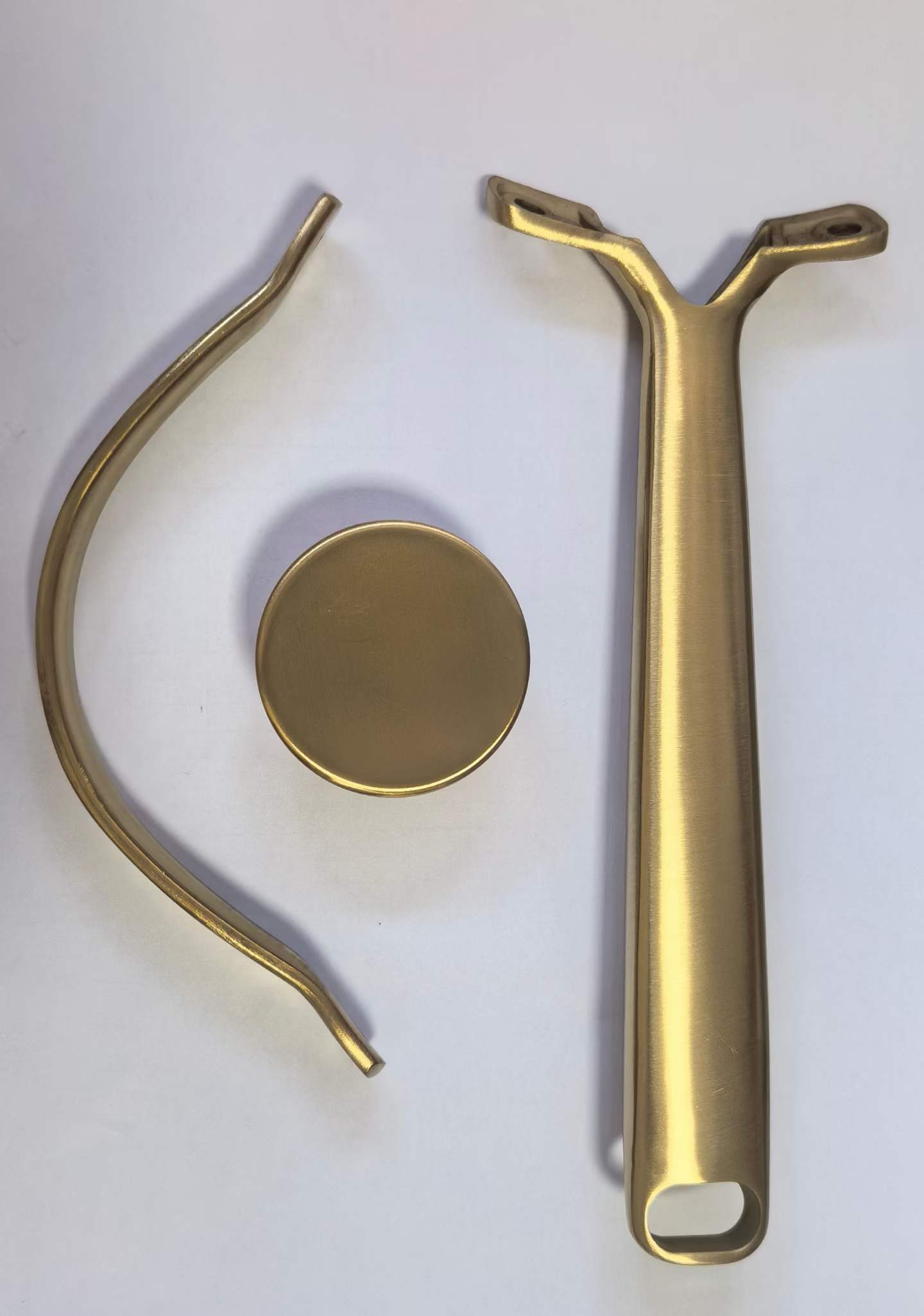 Each process has unique production procedures, cost levels, quality performance and application scenarios. This article systematically introduces their working principles, standard manufacturing steps, advantages and disadvantages to help distinguish and select the most suitable finishing solution.
Each process has unique production procedures, cost levels, quality performance and application scenarios. This article systematically introduces their working principles, standard manufacturing steps, advantages and disadvantages to help distinguish and select the most suitable finishing solution.1. Two Mainstream Factory Gold Plating Processes for Stainless Steel Handles
Stainless steel has a dense passive oxide layer on its surface, which makes direct gold plating extremely difficult with poor adhesion. All formal factory production must adopt standardized pre-treatment and bottom plating processes to ensure the gold layer is firm and uniform. The two mature mass-production methods adopted by hardware factories worldwide are as follows.
1.1 Electroplating Gold (Wet Plating)
Electro gold plating, also known as wet gold plating, is a traditional and cost-effective liquid plating technology. It relies on electrolysis reaction to deposit gold or gold-alloy metal ions on the surface of stainless steel handles. This process has been widely used in hardware finishing for decades due to its simple equipment and low entry cost.
Standard Factory Production Process
Step 1: Surface Degreasing & Cleaning. Remove oil stains, dust and fingerprints on the handle surface with chemical degreasing agents and ultrasonic cleaning to ensure a clean base for subsequent plating.
Step 2: Activation Treatment. Use mixed acid solution to remove the passive oxide film on stainless steel, enhancing the bonding force between the base metal and the coating.
Step 3: Base Plating (Key Procedure). Plate a thin layer of strike nickel first, then a thick nickel or copper bottom layer. This step solves the problem of poor adhesion of direct gold plating on stainless steel and prevents subsequent peeling.
Step 4: Flash Gold Plating. Deposit a ultra-thin gold layer to cover the nickel base, avoiding nickel oxidation and ensuring uniform gold color.
Step 5: Thick Gold Plating. Adjust current density and solution temperature to plate the required gold thickness according to customer requirements.
Step 6: Sealing & Drying. Apply protective sealing agent and high-temperature drying to improve tarnish resistance.
1.2 PVD Vacuum Gold Plating
PVD (Physical Vapor Deposition) vacuum gold plating is a new high-end environmental protection coating technology, which is the mainstream process for high-quality stainless steel handles at present. Under high vacuum environment, the gold target is vaporized into atomic state through physical sputtering and arc evaporation, and forms a dense nano-scale gold-alloy coating on the handle surface through molecular bonding.
Standard Factory Production Process
Step 1: Precision Pre-treatment. Polish, deburr and perform multi-stage ultrasonic deep cleaning on handles to ensure zero impurities on the surface.
Step 2: Vacuum Chamber Loading. Hang the cleaned handles neatly and send them into the high-vacuum coating chamber.
Step 3: Ion Cleaning. Use plasma to bombard the handle surface to further improve coating adhesion.
Step 4: Transition Layer Plating. Plate a thin titanium or chromium bottom layer to enhance wear resistance and bonding stability.
Step 5: Vacuum Gold Deposition. Vaporize the gold target and deposit uniform gold-alloy coating on the handle surface at a constant temperature and vacuum degree.
Step 6: Cooling & Post-protection. Cool down in a vacuum environment, then take out and inspect for packaging.
Advantages of PVD Vacuum Gold Plating
First, super strong durability. The coating is combined with the stainless steel base at the molecular level, featuring excellent scratch resistance and friction resistance. It will not fade or peel off after long-term use. Second, excellent corrosion and high temperature resistance. It can resist kitchen oil fume, acid and alkali erosion, and is suitable for cookware, bathroom and outdoor hardware with high environmental requirements. Third, environmental and safe. The whole process produces no waste liquid and pollution, meets global environmental standards, and the coating is food-grade safe with no harmful substances. Fourth, long service life. The color retention life can reach more than 5 years, and it maintains a stable metallic luster for a long time. Fifth, high texture. The coating is dense and uniform, with delicate luster, better three-dimensional sense and grade than electroplated gold.
2. Core Comparison & Factory Selection Guide
For hardware factories and buyers, electro gold plating is suitable for low-cost, short-cycle, low-end and medium-grade products with low requirements for wear resistance and color retention, such as ordinary furniture handles and low-priced bathroom accessories. PVD vacuum gold plating is the first choice for high-end products such as high-grade cookware handles, luxury bathroom hardware and high-end architectural decorative handles, which require durability, safety, environmental protection and long-term color stability.
Post time: Jun-10-2026